
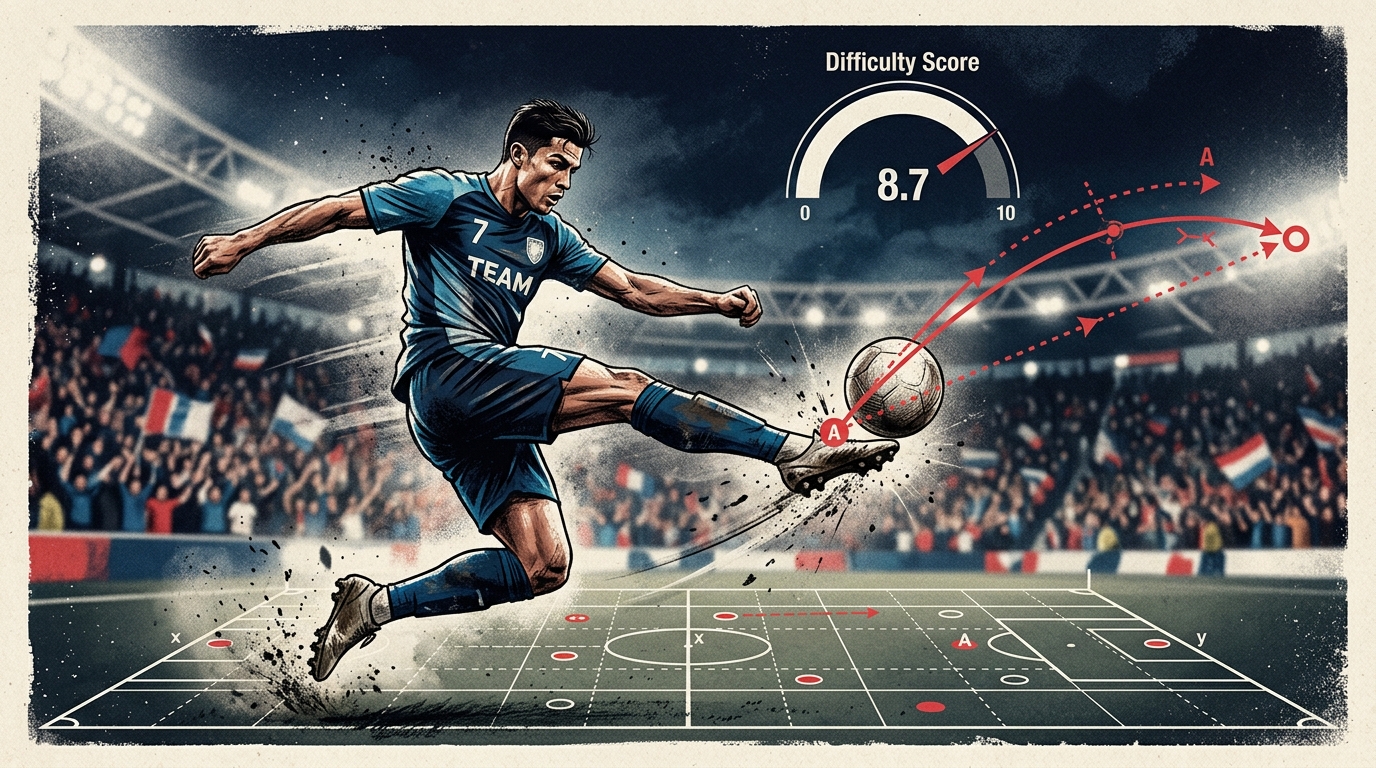
In April 2009, Wolfsburg striker Grafite scored a goal against Bayern Munich that the difficulty methodology has never been able to rank below first in one specific dimension.
In April 2009, Wolfsburg striker Grafite scored a goal against Bayern Munich that the difficulty methodology has never been able to rank below first in one specific dimension.
Grafite finished it without being able to see the goal.
What happened
Wolfsburg were dismantling Bayern, eventually 5-1, on their way to the only league title in the club's history. Grafite received the ball with his back to goal, surrounded, with a defender directly between him and the target and no angle to turn.
He finished it with a backheel. No turn, no sight of the net, no opportunity to measure the keeper or the frame. He struck the ball behind himself, blind, threading it past the defender in the lane and past a keeper he was not looking at.
The variable nobody measures: obstructed vision
Most difficulty inputs assume the player can see what they are aiming at. Shot location, keeper position, the unguarded portion of the frame. All of these presume sight of the target.
This is a fundamentally different and harder problem than finishing with sight of goal, and it is the one variable the broadcast camera is structurally incapable of conveying.
The methodology scores obstructed vision as its own input. Grafite's 2009 backheel maxes it. Nothing scored since has combined that degree of obstruction with that degree of placement.
Where it sits overall, honestly
On total difficulty across all inputs, the goal sits in the top tier of the last twenty years, though not at the very top, because its shot location was friendly. What the goal owns outright is the obstructed-vision axis.
Why you do not remember it
It was scored in the Bundesliga, not a final. It did not enter the loop that the compilation genre runs on.