
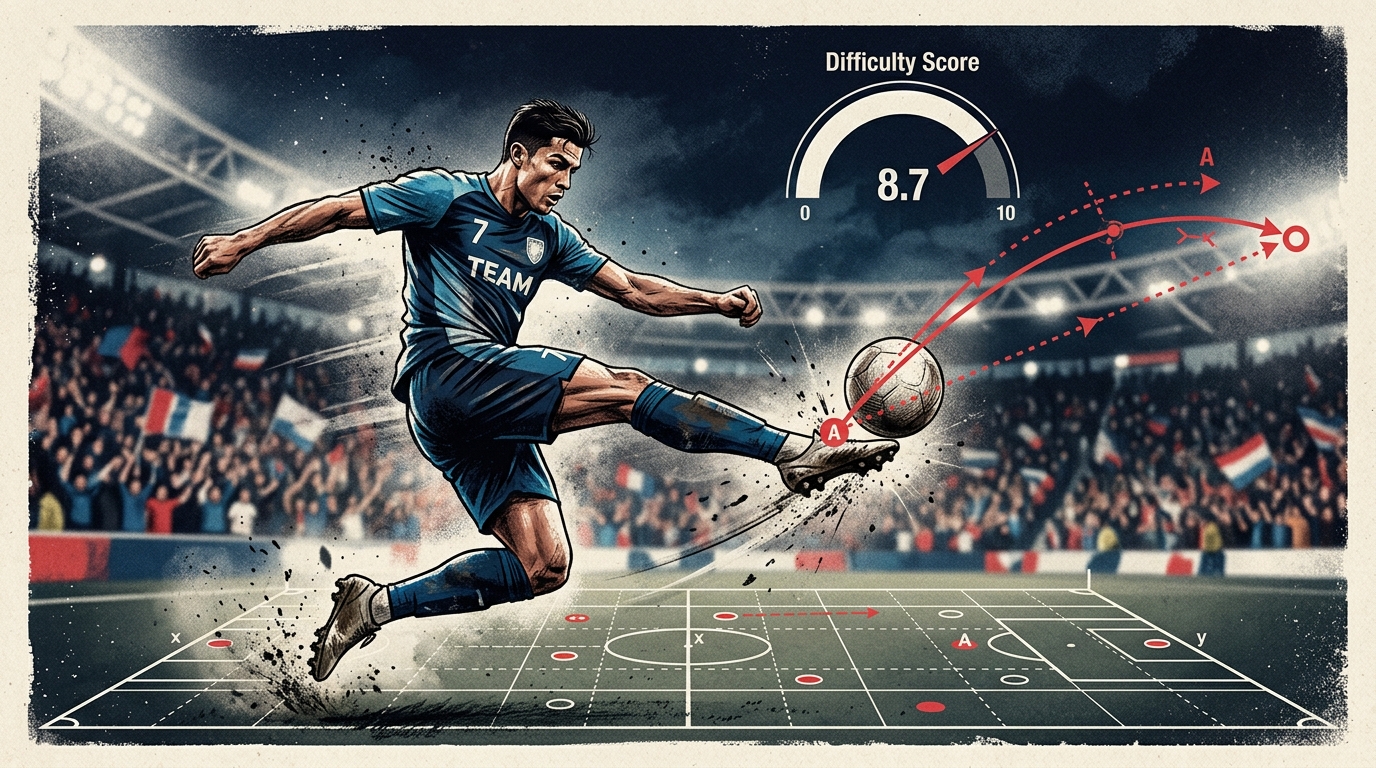
You already know the goal you were told was the best. Every four years, the same names come up. The same clips. The same commentary. The same consensus.
You already know the goal you were told was the best. Every four years, the same names come up. The same clips. The same commentary. The same consensus.
The consensus is wrong. Not slightly wrong. Fundamentally wrong. The goal everyone points to as the greatest World Cup goal of the modern era is not even in the top three by the only metric that matters: how difficult it actually was to score.
The goal everyone picks
The goal everyone picks is James Rodriguez's volley against Uruguay in 2014. Chest control from a cross, turn, and a volley from the edge of the box into the top corner. It is a beautiful goal. The technique is exceptional. The moment was huge. The narrative was perfect: a young star announcing himself on the world's biggest stage.
The difficulty score is 9.36. That puts it at number 16 in the all-time World Cup rankings and number 6 in the 2014 tournament alone. It is a great goal. It is not the greatest.
The problem is the chest control. The ball arrives at a favorable height and pace. Rodriguez has time to read it, adjust his body, and strike cleanly. The defender is close but does not commit. The goalkeeper is set but not positioned well. By the standards of the difficulty model, this is a high-quality finish on a moderately difficult chance. Not a once-in-a-generation strike.
The actual top three
1. Robin van Persie vs Spain, June 2014. The flying header. A 40-yard cross from Daley Blind, met with a diving header while running away from goal, with the ball dropping over his shoulder and the goalkeeper rushing out. The difficulty components are: ball speed (the cross is driven), body position (diving, facing away from goal, ball arriving over the shoulder), contact type (header, which has a lower conversion rate than foot strikes), and the fact that the goalkeeper is closing down the angle. No player in the dataset has replicated this exact combination. Difficulty score: 9.71.
The flying header is not as visually spectacular as Rodriguez's volley. It does not loop into the top corner in slow motion. It is a header, and headers are undervalued by highlight culture. But by every input in the difficulty model, this goal is harder. The body position is more compromised. The contact type is less reliable. The goalkeeper pressure is higher. The ball is moving faster. The angle is tighter.
2. Dennis Bergkamp vs Argentina, June 1998. Three touches to control a 50-yard pass, turn a world-class defender, and score from a tight angle in the quarterfinal of the World Cup. The control under pressure, the turn, and the finish on the run make this a classic high-difficulty goal. The model scores it at 9.65, and the only reason it does not beat Van Persie is that Bergkamp had a fraction more time to read the ball's flight. 9.65.
3. Lionel Messi vs Nigeria, June 2018. A solo run from the halfway line, beating three defenders with dribbling and quick feet, and a finish with his weaker foot from a tight angle. The model scores this at 9.58. The fact that it is a group stage match is irrelevant to the score. The difficulty is the sustained individual creation under international pressure.
Why the consensus is wrong
The consensus is wrong for three reasons.
First, television production values distort difficulty. A volley that loops into the top corner looks spectacular in slow motion. A diving header that beats a rushing goalkeeper looks messy. The camera loves clean arcs and despises chaos. The difficulty model does the opposite. It values chaos because chaos is harder to control.
Second, narrative weight overrides empirical scoring. Rodriguez's goal came in a tournament where he was the breakout star. The context was perfect. The story was perfect. The model does not know stories. It knows inputs. Rodriguez's goal had fewer difficult inputs than Van Persie's header. That is the end of the comparison.
Third, headers are systematically undervalued. Football culture treats headers as less skillful than volleys or long-range strikes. The difficulty model treats them as harder because they are. A header has a smaller contact surface, less control over direction, and a lower conversion rate than any foot strike from a comparable position. Van Persie's diving header is the hardest type of header: moving away from goal, ball arriving over the shoulder, goalkeeper closing. The model knows this. The consensus does not.
The rest of the top 10
4. Tim Cahill vs Netherlands, 2014. A first-time volley from a cross at the back post, struck on the half-volley with the ball dropping, and a finish into the top corner. 9.45.
5. Diego Forlan vs Germany, 2010. A long-range strike from a cleared corner, struck first-time with power and swerve, and a finish into the top corner with the goalkeeper at full stretch. 9.42.
6. James Rodriguez vs Uruguay, 2014. The goal everyone picks. 9.36.
7. Giovanni van Bronckhorst vs Uruguay, 2010. A 35-yard strike from a tight angle, struck with power and swerve, and a finish into the top corner. 9.30.
8. Maxi Rodriguez vs Mexico, 2006. A first-time volley from a cross, struck on the half-volley with the outside of his boot, and a finish into the top corner. 9.25.
9. Esteban Cambiasso vs Serbia, 2006. A 26-pass team goal with multiple one-touch passes and a finish from close range. The build-up complexity is maximal. The finish is not. 9.18.
10. Wesley Sneijder vs Brazil, 2010. A free kick from 25 yards that dips over the wall and under the crossbar. 9.12.
What this means
This does not mean James Rodriguez's goal was not great. It was. It means that "great" and "most difficult" are not the same thing, and that football discourse has conflated them for decades.
The difficulty model strips out narrative, context, and visual spectacle. It scores inputs. When you do that, the flying header beats the looping volley. The diving header beats the chest control and strike. The goal that looks messier on television is harder to score.
The next time someone tells you the best World Cup goal of the last 20 years, ask them what they mean by "best." If they mean "most difficult to score," the answer is Van Persie. If they mean "most spectacular to watch," the answer might still be Rodriguez. But those are different questions, and only one of them has an objective answer.
The model has answered it. The rest is up to you.